
Science & Technology II India's Semiconductor Mission 2.0
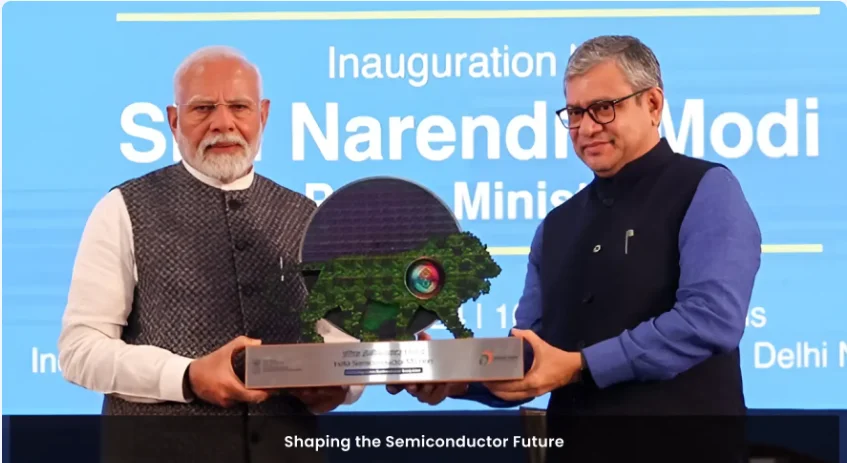
The India Semiconductor Mission (ISM) aims to build a strong semiconductor and display ecosystem, positioning India as a global hub for electronics manufacturing and design, while serving as the nodal agency for the efficient and seamless implementation of semiconductor and display schemes.
What is a Semiconductor?
These are crystalline solid materials that have electrical conductivity between that of a conductor and an insulator. They are the foundation of modern electronics and power a vast array of technologies such as computers, smartphones, solar panels, and medical devices. Semiconductors are employed in the manufacture of various kinds of electronic devices, including diodes, transistors, and integrated circuits. Such devices have found wide application because of their compactness, reliability, power efficiency, and low cost.
Indian Semiconductor Mission (ISM 2021)
Vision. To build a vibrant semiconductor and display design and innovation ecosystem to enable India’s emergence as a global hub for electronics manufacturing and design.
Aim. The programme aims to provide financial support to companies investing in semiconductors, display manufacturing and design ecosystem.
Launched in 2021 with a total financial outlay of Rs76,000 crore under the aegis of the Ministry of Electronics and IT (MeitY).It is part of the comprehensive program for the development of sustainable semiconductor and display ecosystem in the country.
India Semiconductor Mission (ISM) has been setup as an Independent Business Division within Digital India Corporation. ISM has all the administrative and financial powers and is tasked with the responsibility of catalysing the India Semiconductor ecosystem in manufacturing, packaging and design.
ISM has an advisory board consisting of some of the leading global experts in the field of semiconductors. ISM is serving as the nodal agency for efficient, coherent and smooth implementation of the programme for development of semiconductor and manufacturing ecosystem in India.
Objectives of ISM.
· Formulate a comprehensive long-term strategy for developing sustainable semiconductors and display manufacturing facilities and semiconductor design eco-system in the country in consultation with the Government ministries / departments / agencies, industry, and academia.
· Facilitate the adoption of secure microelectronics and developing trusted semiconductor supply chain, including raw materials, specialty chemicals, gases, and manufacturing equipment.
· Enable a multi-fold growth of Indian semiconductor design industry by providing requisite support in the form of Electronic Design Automation (EDA) tools, foundry services and other suitable mechanisms for early-stage startups.
· Promote and facilitate indigenous Intellectual Property (IP) generation.
· Encourage, enable and incentivize Transfer of Technologies (ToT).
· Establish suitable mechanisms to harness economies of scale in Indian semiconductor and display industry.
· Enable cutting-edge research in semiconductors and display industry including evolutionary and revolutionary technologies through grants, global collaborations and other mechanisms in academia / research institutions, industry, and through establishing Centres of Excellence (CoEs).
· Enable collaborations and partnership programs with national and international agencies, industries and institutions for catalyzing collaborative research, commercialization and skill development.
Components. There are four schemes under ISM
ü Scheme for setting up of Semiconductor Fabs in India. Provides fiscal support to eligible applicants for setting up of Semiconductor Fabs which is aimed at attracting large investments for setting up semiconductor wafer fabrication facilities in the country.
ü Scheme for setting up of Display Fabs in India. Provides fiscal support to eligible applicants for setting up of Display Fabs which is aimed at attracting large investments for setting up TFT LCD / AMOLED based display fabrication facilities in the country.
ü Scheme for setting up of Compound Semiconductors / Silicon Photonics / Sensors Fab and Semiconductor Assembly, Testing, Marking and Packaging (ATMP) / OSAT facilities in India. The Scheme provides a fiscal support of 30% of the Capital Expenditure to the eligible applicants for setting up of Compound Semiconductors / Silicon Photonics (SiPh) / Sensors (including MEMS) Fab and Semiconductor ATMP/OSAT(Outsourced Semiconductor Assembly and Test) facilities in India.
ü Semicon India Future Design: Design Linked Incentive (DLI) Scheme. It offers financial incentives, design infrastructure support across various stages of development and deployment of semiconductor design for Integrated Circuits (ICs), Chipsets, System on Chips (SoCs), Systems & IP Cores and semiconductor linked design.
What is it Significance to Indian ?
The semiconductor industry is crucial for India due to its foundational role in modern technology, its potential for economic growth, and its impact on national security and self-reliance. Semiconductors are the building blocks of all electronic devices, from smartphones to electric vehicles, and India's growing digital economy is driving demand for these chips.
Long Term Strategy – Global Manufacturing Hub. In organizing efforts for promoting semiconductors and display industry in a more structured, focused, and comprehensive manner as a long-term strategy.
Global Technology Powerhouse – Electronics & Design. ISM will also promote and facilitate indigenous Intellectual Property (IP) generation and encourage, enable and incentivize Transfer of Technologies (ToT). ISM in future will lead to enable collaborations and partnership programs with national and international agencies.
Economic Growth and Job Creation. The semiconductor industry is a high-value sector with the potential to attract substantial investments and generate numerous jobs. India aims to capture a significant share of the global semiconductor market, projected to reach $1 trillion by 2030. Developing a domestic semiconductor ecosystem will boost India's manufacturing capabilities and competitiveness.
National Security and Self-Reliance. Reducing reliance on foreign suppliers for critical components is essential for national security. A robust domestic semiconductor industry will ensure a steady supply of essential components for various sectors, including defense. Self-reliance in this key technology area will strengthen India's strategic position globally. India’s own consumption of semiconductors is expected to cross USD 80 billion by 2026 and to USD 110 billion by 2030. Developing a domestic semiconductor industry will reduce India's reliance on imports, boost domestic manufacturing, and create jobs.
Technological Advancement. Investing in semiconductor manufacturing encourages research and development, fostering innovation and technological advancements. India's participation in the Fourth Industrial Revolution, which heavily relies on semiconductors, is dependent on building a strong semiconductor ecosystem. Developing cutting-edge technologies in this field will position India as a leader in the global technology landscape.
Embracing the Digital Economy. Semiconductors are fundamental to India's growing digital economy, powering smartphones, laptops, and other essential devices. The demand for semiconductors is increasing rapidly due to the expanding digital landscape and the proliferation of smart devices. By investing in domestic semiconductor manufacturing, India can ensure a reliable supply of chips to meet the growing needs of its digital economy.
What are the Approved Projects in Indian Semiconductor Mission ?
Semiconductor Fabs
· Tata Electronics Private Limited (TEPL) Fab. Joint venture with Powerchip Semiconductor Manufacturing Corp (PSMC) to set up a fab in Dholera, Gujarat, with a capacity of 50,000 wafers per month and an investment of Rs 91,000 crore.
· HCL and Foxconn Joint Venture. A unit in Uttar Pradesh near the Jewar airport to manufacture display driver chips for various devices, with an investment of Rs 3,700 crore.
ATMP/OSAT Facilities
· Tata Semiconductor Assembly and Test Pvt Ltd (TSAT) in Morigaon, Assam. An ATMP unit with a capacity of 48 million units per day, developing indigenous advanced semiconductor packaging technologies.
· CG Power and Industrial Solutions Limited. A joint venture with Renesas Electronics America Inc. and STARS Microelectronics to set up an OSAT facility with a production capacity of 15.07 million units per day.
· Kaynes Technology India Limited (KTIL). An OSAT facility in Sanand, Gujarat, with a capacity to produce more than 6.33 million chips per day by late FY 2026.
Startups and Institutions. Over 70 startups and 270 institutions are actively engaged in semiconductor innovation in India.
India-Japan Collaboration. A Memorandum of Cooperation (MoC) has been signed between India and Japan to strengthen the semiconductor supply chain partnership.
Overall, the India Semiconductor Mission is progressing with significant momentum, attracting investments, fostering collaborations, and building a strong foundation for a self-reliant semiconductor industry in India
Conclusion. The semiconductor industry is not just an economic driver for India; it's also a strategic imperative for national security, technological advancement, and self-reliance. India's commitment to building a robust semiconductor ecosystem positions it to become a global leader in this critical technology.
India Shinning …..